Why after 15 years
of unconvincing tests, we now start using "synthetic"
seals too.
The story begins in 1992, when we tried for the first
time a hundred of silicon-based seals produced and used
-at that time- only in the USA. Many other experiences
and experiments followed, with seals of both italian
and foreign manufacture; all of them were presented
by companies convinced of having reached the technical
perfection.
The problems we found were not about any transmission
of a "synthetic" smell or taste to the wine,
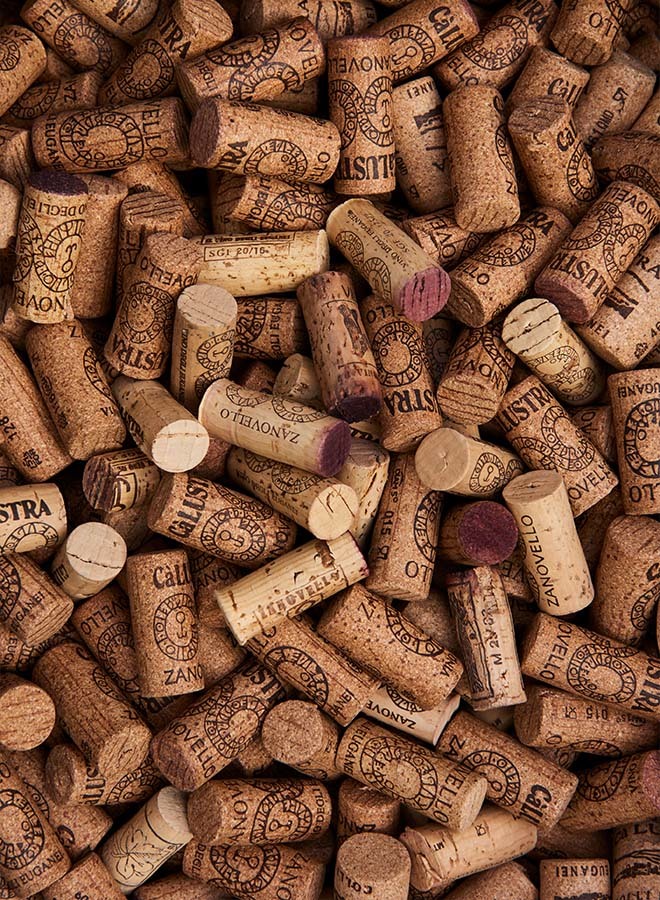
but the lack of the two great abilities of cork. Not
to mention the esthetic and emotive impact.
So, cork has these two main abilities:
a) it keeps its elasticity and so the ability to preserve
certain wines for 10/20 till 30 years and more
b) it allows a minimum but important permeability to
the air, and this allows to important wine the slow
maturation in the bottle.
We all know the other side of using cork, particularly
when it happen to open a bottle with a clear defect,
but you can find noticeable differences -after some
months or years from bottling- between bottles sealed
with even the same lot of cork: it's hard to get real
consistence.
Cork comes now from averagely younger trees, sometimes
grown in areas where it was missing since long ago:
this implies a certain non homogeneity on the phisycal-technical-sanitary
qualities of the lots; and no industry treatment can
really fix this.
In truth, I met in Sardinia some extraordinary man who
selecting from enormous racks of wood with very skilled
hand-eyes-nose one slice of cork at a time, than makes
with old time skills 5-600 corks per day, one by one...
maybe when we'll produce some Magnum and a really great
red wine, than I'll go there to get these corks, whose
price is, or let say flies, easily over one euro a piece.
But what we need is to solve the everyday problems.
The more precious and expensive is a bottle of wine,
the more strong and legitimate is the customer's expectation
of a gratifying consumption. And it's always a big disappointment,
and a waste of money, to get a bottle ruined by a bad
cork. It doesn't matter if it is because of the usual
mold, an excessive oxydation or some bitter taste.
Three years ago happened our first encounter with the
seals produced by Guala spa, a holding from Piedmont.
Their product is indeed a bit complicate, and I suggest
to visit their website ( www.gualaseal.com
) if you are willing to go deeper inside this technology.
Anyway, this technical seal is calibrated on the best
corks the market can offer, and is the result of years
of serious experimentation. It still is something new
in the italian market, but it's well known and used
in France, particularly in Bordeaux and Burgundy.
Maybe it won't encounter everyone's taste, from an emotive
point of view, but after nearly one hundred of blindly
tasted wines - compared with the same sealed with classic
cork, I can say I preferred the traditional one only
in two cases, also after three years from bottling.
We think we found something good and worth to try. Anyway,
we won't stop looking for alternatives.
Franco Zanovello |
|
|
|
|